1 / 3
佛罗伦萨大教堂
SSimplyAnnisa原创
发布者:Radishon[CITY] = Florence
[COUNTRY] = Italy
[LANDMARK] = Florence Cathedral / Cathedral of Santa Maria del Fiore / Il Duomo di Firenze
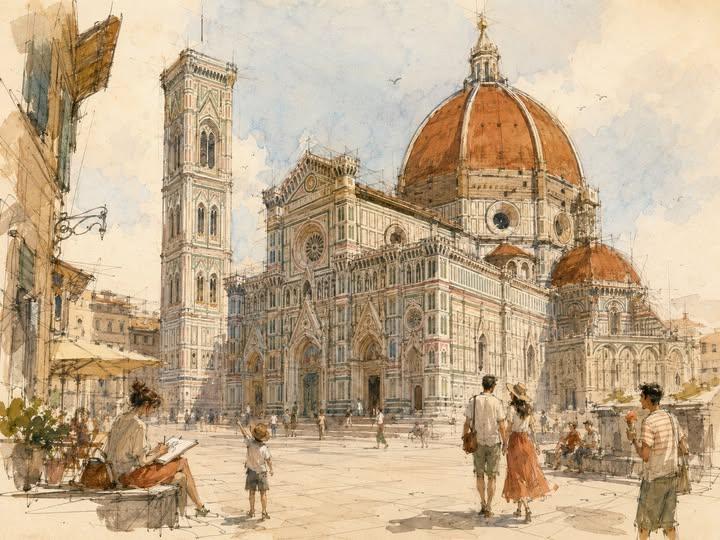
Create a wide landscape-format illustration inspired by Florence, Italy, with Florence Cathedral, also known as the Cathedral of Santa Maria del Fiore or Il Duomo di Firenze, as the main recognizable emotional and visual anchor.
Core concept:
Do not depict the Duomo as a realistic postcard or architectural record. Instead, illustrate how this place is remembered emotionally: its breathtaking scale, terracotta dome rising above the city, marble patterns, Renaissance elegance, warm Tuscan light, echoing piazza, slow footsteps, and small human moments of wonder.
Reimagine Florence Cathedral as a living sketch of memory: grand, graceful, slightly imperfect, expressive, and full of gentle personality. The image should feel like a refined visual development sketch for an animated film, combining loose character-concept-art energy with architectural sketch sensitivity.
The scene should feel warm, cultured, atmospheric, lightly cinematic, slightly nostalgic, and quietly magical. It should look as if an artist observed the cathedral carefully, then redrew it from memory with imagination rather than precision.
Style direction:
Use a loose character-concept-art and architectural sketch style.
The architecture should feel expressive, not mechanically accurate.
The cathedral should have a personality, almost like a majestic old storyteller.
Use visible construction lines, loose perspective guides, exploratory pencil marks, imperfect edges, lively sketchy outlines, and slightly unfinished drawing traces.
Combine hand-drawn ink, pencil sketch, soft watercolor wash, light gouache patches, and subtle digital painting only where needed.
The final image should feel handmade, tactile, and alive, not polished or sterile.
Landmark treatment:
Florence Cathedral must remain recognizable through its essential spatial character, scale, silhouette, architectural identity, and iconic features.
Include Brunelleschi's massive terracotta dome, the white-green-pink marble facade pattern, Giotto's bell tower, pointed Gothic details, arched windows, and the broad piazza atmosphere.
Simplify these features into readable shapes, expressive architectural rhythms, playful proportions, and layered sketch elements.
Do not over-render every marble pattern or ornament. Suggest them with loose geometric strokes, delicate color blocks, and imperfect linework.
Preserve the emotional truth of the Duomo more than exact detail.
Show enough distinctive structure so viewers can identify Florence Cathedral, but avoid rigid architectural precision.
Human and narrative details:
Include small expressive people only where they help tell the feeling of the place.
Characters should be tiny, quirky, minimally detailed, and full of gesture.
Use small narrative moments: visitors looking up at the dome, a person sketching in the piazza, someone carrying a gelato, a couple crossing the square, a child pointing at the bell tower, or quiet figures resting in the warm shade.
Avoid dense crowds. Each figure should feel intentional.
The human details should create warmth and scale, not clutter.
Composition:
Use a wide horizontal landscape format.
Keep Florence Cathedral as the main focal point.
Let the terracotta dome become the strongest visual silhouette.
Use asymmetrical balance, loose perspective, and gently exaggerated shapes.
Leave generous negative space so the image can breathe.
Use large clean areas of warm paper, pale Tuscan sky, or open piazza.
The scene should feel poster-like, readable, and elegant from a distance.
Do not fill every corner.
Let emptiness carry part of the emotion.
Color palette:
Use a warm, muted, lightly desaturated palette inspired by Florence.
Suggested colors: soft off-white paper, pale blue-gray sky, warm limestone cream, dusty beige, ochre, muted terracotta, faded rose, pale green marble, olive green.